11 Best YNAB Alternatives in 2026 (From $1.99/mo)
May 10, 2026
Updated September 15, 2026
11 YNAB alternatives ranked by a founder who tried them — from $1.99/mo. The cheapest, the closest clone, the best free tier, and the best free tracker, compared honestly.
Take control of your money with BudgetLabs
Free forever — premium features just $1.99/mo. No credit card required.
Sign Up NowWhen I tell people I built a budgeting app, the first thing they ask is "how is it different from YNAB?" The second thing — once they've decided YNAB isn't for them — is "okay, then what should I use?"
This post is the long answer to the second question. It's also a confession up front: I built one of the apps on this list (BudgetLabs). That conflict of interest is why the rest of this needs to be honest. I'm not going to fluff my own listing. If you walk away picking one of the other apps, I want it to be because you read a fair comparison, not because I tried to sell you something that doesn't fit.
The side-by-side at a glance
| App | Monthly | Annual | Free tier | Bank sync | Method | Best for |
|---|---|---|---|---|---|---|
| YNAB | $14.99 | $109 | No (34-day trial) | Optional | Zero-based, rule-driven | Methodology + community |
| BudgetLabs | $1.99 | $19.99 | Yes (full core loop) | No (semi-manual + AI Smart Import) | Zero-based, flexible | AI + Family Sharing + active budgeting |
| Monarch | $14.99 | $99.99 (Core), $199 (Plus) | No (7-day trial) | Yes | Tracking + planning | Wealth-tracker households |
| EveryDollar | $17.99 (Premium) | $79.99 (Premium) | Yes (manual only) | Premium only | Zero-based (Ramsey) | Dave Ramsey followers |
| Goodbudget | $10 | $80 | Yes (10 envelopes) | No | Envelope | Envelope traditionalists |
| Actual Budget | $4 (hosted) | — | Free (self-host) | Yes (SimpleFIN add-on) | Zero-based, YNAB-clone | Self-hosters / open-source |
| Simplifi | $5.99 | $35.88 (intro) | No (30-day trial) | Yes | Tracking + planning | Quicken refugees |
| Waypoint | $7.99 CAD | $59.99 CAD | Limited | Optional | Zero-based | Cheap YNAB clone |
| Copilot Money | $13 | $95 (Standard); Family tier extra | No (30-day trial) | Yes (Plaid) | Tracking + planning | Premium polish + investments |
| Empower | Free | Free | Yes (full dashboard) | Yes | Tracking / net worth | Free net-worth + investment tracking |
| PocketGuard | $12.99 | $74.99 | Yes (2 accounts) | Yes | Tracking ("In My Pocket") | Simple "safe to spend" |
Quick read: among the budgeting apps, BudgetLabs and Goodbudget are the two with genuinely usable free tiers. Empower's dashboard is free too, but it's a tracker, not a zero-based budget. Monarch, YNAB, and Copilot are clustered at the top of the pricing range. EveryDollar's free tier exists but is widely considered demo-grade. Pricing checked June 2026.
Why people are leaving YNAB in 2026
YNAB built the modern personal-finance budgeting category. The Four Rules, the methodology, the community — none of that would exist without them. Most people on this list are here because YNAB raised the bar.
But the price kept going up. $5/mo became $11.99/mo became $14.99/mo without proportional value increase. The Plaid bank-sync renegotiation in 2023 made auto-import less reliable. The methodology, while powerful, takes weeks of YouTube and podcasts to internalize. People who started YNAB in 2018 and bounced off in 2024 are looking around — and there are way more options now than there were three years ago.
So this is a snapshot of the field as of mid-2026. Pricing checked this month; if anything has shifted, the rough rankings still hold but verify before subscribing.
How I evaluated these
For each app, I looked at:
- Price — monthly and annual, free tier reality, what the paid tier actually unlocks
- Methodology — zero-based, envelope, flexible, pure tracking
- Bank sync — yes, optional, paid-only, never
- Platforms — iOS, Android, Mac, web, desktop
- Transaction entry support — does it work as a semi-manual workflow, or is bank sync required to function?
- Distinctive strength — the one thing it does better than anyone else
- Honest weakness — the trade-off you accept by picking it
Per-app deep dives
1. YNAB — best for methodology + community
What it is: The original modern zero-based budgeting app. Four Rules. "Give every dollar a job." Educational ecosystem of YouTube, podcasts, books, certified coaches.
Where it shines:
- Methodology depth no one else matches
- Active, helpful Reddit and Facebook communities
- Mature mobile apps on both iOS and Android
- Bank sync is optional — users can run it manual-only
Where it falls short:
- $14.99/mo is the highest in the category and went up multiple times in recent years
- Steep learning curve — methodology requires real time investment to internalize
- Bank sync via Plaid has had reliability issues since the 2023 renegotiation
- Doesn't handle irregular freelance income gracefully without contortions
- No native investment portfolio view
Best for: Someone willing to pay for the methodology + community ecosystem and who wants the gold-standard zero-based tool. Deciding between YNAB and one specific rival? The head-to-heads: YNAB vs Monarch and YNAB vs EveryDollar.
2. BudgetLabs — best for active budgeting at $1.99/mo
What it is: The one I built. A complete zero-based budgeting app at $1.99/mo — Family Sharing for households, an AI assistant (Hank) plus Smart Import and Receipt Scanning for fast entry, Goals for debt payoff and savings targets, built-in transaction amortization for annual bills, and the Lab (Insights, Scenarios, Goals, Terminal) for testing what-ifs. Semi-manual entry by design — with AI shortcuts making it fast.
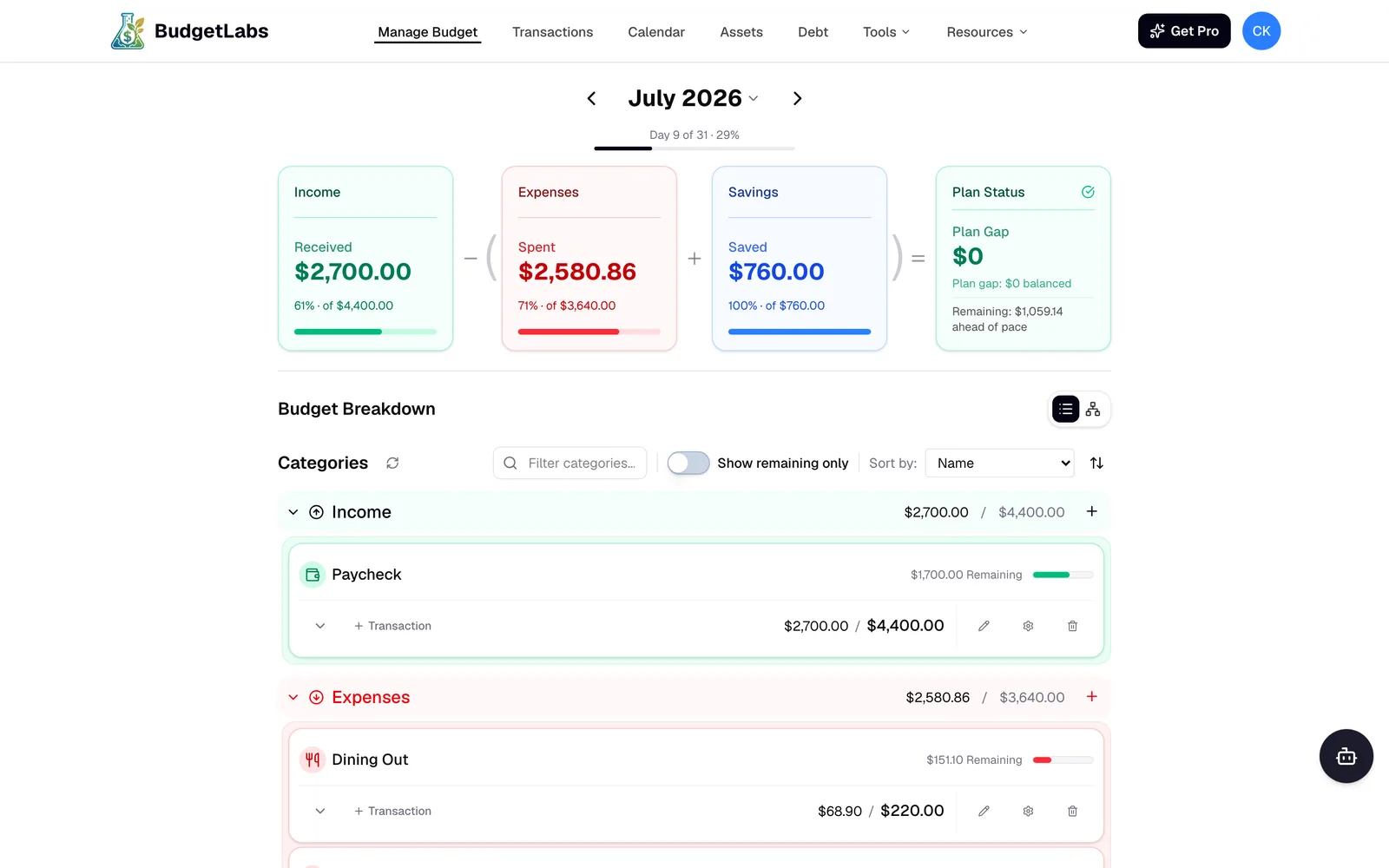
The BudgetLabs dashboard mid-month — every dollar assigned, plan gap $0. See the full five-screen product tour →
Where it shines:
- $1.99/mo is the lowest paid tier in the category, and the free tier covers the full core loop (categories, transactions, debt, assets, the Lab)
- Transaction Amortization is built in — spread a $1,200 annual insurance bill across 12 months in one tap, no sinking-fund side ledger to maintain
- Annual Events Planner handles 1, 2, 3, 5, or 10-year renewals (passport, concealed-carry permit, registration) — most apps don't even acknowledge this category exists
- AI Money Coach (Hank) answers natural-language questions about your own budget; Smart Import handles bank statements via paste, PDF, screenshot, or even drag-an-email-in — you review and approve before anything lands (one import a day free, 100 a day on Pro)
- Goals (Lab > Goals) projects current pace vs. on-track trajectory in real time with draggable contribution sliders
- Asset Contribution Tracking for 401(k)/IRA/HSA accounts with employer-match modeling and IRS contribution-limit warnings
- Debt payoff forecasting — avalanche or snowball, with live recalculation when you change the payment
- Net worth tracked over time — see whether your overall position is improving month by month
- Family Sharing — one $1.99/mo Pro subscription covers up to 5 members on a shared budget, no per-seat charge (Goodbudget Plus costs $80/yr for the same 5-seat ceiling; Monarch/YNAB/Copilot Family run $99-$199/yr)
- Platforms — iPhone, iPad, Mac (browser), and Desktop. Available anywhere a browser runs.
- Founder-led — feature requests typically ship within a week
Where it falls short:
- iOS-only on native mobile right now (iPad, Mac browser, and Desktop are all covered; Android native is on the roadmap, not shipped)
- Smaller community than YNAB / Monarch / EveryDollar — fewer tutorials, smaller subreddit
- No bank sync, ever — a deliberate philosophy, but a real con if you want set-and-forget
- No live brokerage sync for investments — holdings can be entered by hand or scanned from a statement, and allocation is charted against a target, but nothing updates automatically and dividends and per-security returns aren't computed
- Newer product — less battle-tested than 15-year-old YNAB
- Free tier limits Hank to 5 chats/day and Smart Import to 1 import/day; full AI requires Pro
Best for: People who want a full-featured zero-based budgeting app at a fraction of YNAB's price — Family Sharing for households, an AI assistant and Smart Import for fast entry, Goals for debt payoff and savings, transaction amortization, debt payoff forecasting, and cross-month flexibility, all built in.
3. Monarch Money — best for wealth-tracking households
What it is: The most polished personal-finance dashboard on the market. Net worth tracking, investment views, household sharing baked in. Started as the YNAB alternative for couples who wanted prettier UI.
Where it shines:
- Beautiful UI — arguably the best in the category
- Strong investment + net worth tracking
- Household sharing is mature and well-integrated (up to 5 members on Premium)
- Mature on iOS, Android, web
Where it falls short:
- $14.99/mo (Core) tied with YNAB; new Plus tier in 2026 at $199/yr signals price ladder
- Methodology-light: encourages tracking-after-the-fact rather than deciding-before-spending
- Bank sync via Finicity/Plaid can produce duplicate or stale transactions
- Heavy onboarding flow can feel like the app is teaching you how it works rather than helping you budget
- No envelope-style category caps — easy to drift into "watch your money" mode
Best for: Couples who want a shared wealth-tracking dashboard and don't need disciplined budget execution. If it's down to Monarch and one other app, we've refereed the big matchups: YNAB vs Monarch and Copilot vs Monarch.
4. EveryDollar — best for Dave Ramsey followers
What it is: Ramsey Solutions' app. Built around the Baby Steps and total money makeover methodology. Free tier is manual-entry; Premium adds bank sync.
Where it shines:
- Plug-and-play with the Ramsey ecosystem (Financial Peace University, Baby Steps)
- Simpler than YNAB — less methodology to internalize
- Free tier exists with full manual workflow
- Active community of Ramsey followers
Where it falls short:
- Premium ($17.99/mo or $79.99/yr) is the highest monthly price in this comparison; bank sync is paywalled
- Dave Ramsey methodology baked deep — anti-credit-card stance, debt snowball default, no margin for users with different views
- Custom date ranges and detailed reporting are limited
- No amortization or "borrow from future months" concept
- App Store reviews flag occasional sync reliability issues even on Premium
Best for: People actively following the Ramsey Baby Steps who want the official tool and can stomach the price for bank sync. Torn between the two zero-based heavyweights? YNAB vs EveryDollar settles it.
5. Goodbudget — best for envelope traditionalists
What it is: A digital version of the classic envelope system. You create envelopes, fill them with allocated dollars, and stop spending in a category when the envelope is empty.
Where it shines:
- Pure envelope methodology, faithfully implemented
- Free tier (10 envelopes) is genuinely usable
- Family sharing on the free tier (2 members free, 5 on Plus)
- Manual entry by design — no bank-sync mess to manage
Where it falls short:
- UI feels dated compared to Monarch / YNAB
- Limited reporting and analytics
- No AI features, no advanced forecasting
- Envelope methodology is rigid by design — not for everyone
Best for: Envelope-method loyalists who want a simple, distraction-free implementation.
6. Actual Budget — best for self-hosters
What it is: Open-source YNAB clone. Self-host for free, or pay $4/mo for hosted. Bank sync via the SimpleFIN add-on (separate cost).
Where it shines:
- Open source — your data, your server, no vendor lock-in
- YNAB-style methodology without the YNAB price
- Active dev community, regular updates
- Hosted version is the cheapest non-free paid option here
Where it falls short:
- Self-hosting requires technical chops most users don't have
- Bank sync via SimpleFIN means another paid service
- Mobile experience is less polished than competitors
- Smaller community than YNAB or Monarch — fewer YouTube tutorials, smaller subreddit
Best for: Tinkerers and developers who self-host and want a YNAB-grade tool without YNAB's price or proprietary lock-in.
7. Simplifi (by Quicken) — best for Quicken refugees
What it is: Quicken's modern entry. Built to recapture the longtime Quicken user base who never moved to a SaaS budgeting app. Bank sync, planning, projections.
Where it shines:
Take control of your money with BudgetLabs
Free forever — premium features just $1.99/mo. No credit card required.
Sign Up Now- Familiar to anyone who used Quicken in the 2000s/2010s
- Bank sync that handles a wide range of US institutions
- Cheaper than YNAB or Monarch
- Solid spending-trend reporting
Where it falls short:
- Quicken brand baggage — perception of being legacy software
- Bank sync reliability complaints recur in App Store reviews
- Less methodology discipline than YNAB or EveryDollar
- Annual price after the intro period jumps significantly
Best for: Former Quicken desktop users who want a modern app without changing tribes. (Weighing it against the prettiest tracker instead? See Monarch vs Simplifi.)
8. Waypoint Budget — best for cheap YNAB clone
What it is: A newer Canadian-built budgeting app explicitly positioned as a YNAB alternative at a fraction of the price.
Where it shines:
- Direct YNAB-style zero-based methodology
- Half the price of YNAB
- Active development, responsive founder
Where it falls short:
- Newer / smaller — fewer users, less battle-tested
- $7.99 CAD pricing can confuse US shoppers
- Smaller ecosystem of integrations and tutorials
- Less brand recognition than the established players
Best for: YNAB devotees who want the same methodology at half the price and don't mind a smaller community.
9. Copilot Money — best for premium polish and live investment tracking
What it is: A premium Apple-first personal-finance app. Polished UI, AI-powered transaction categorization, live brokerage sync for investment portfolios. Won an Apple Design Award.
Where it shines:
- Best-in-class UI polish for Apple users
- Live brokerage sync — holdings, dividends, returns
- AI-powered auto-categorization that learns over time
- Native macOS app (not just web)
Where it falls short:
- $13/mo or $95/yr Standard, with household sharing on a pricier Family tier — premium pricing
- Auto-sync model encourages passive observation, not active budgeting
- No Android app; the web app (which now exists) isn't yet feature-complete, and it's US institutions only
- Bank connections required for full experience (Plaid)
- Family Sharing locked behind the Family tier
Best for: Apple users who want a beautifully designed auto-sync tracker with live investment data and don't mind the premium price. If you're weighing exactly these two, the YNAB vs Copilot head-to-head settles the method-vs-polish question in detail — and if it's Copilot against the other big dashboard, see Copilot vs Monarch.
10. Empower (Personal Capital) — best free net-worth tracker
What it is: A free financial dashboard, rebranded from Personal Capital in 2023. Net-worth tracking, investment-portfolio analysis, retirement planning, and cash-flow tools — all free. Empower makes its money from an optional paid wealth-management advisory service (0.49%–0.89% of assets under management), not from the app itself.
Where it shines:
- Genuinely free — the dashboard, budgeting view, net-worth tracker, and investment analyzer cost nothing
- Best-in-class investment and net-worth analytics for a free tool
- Strong retirement planner and fee analyzer
- Great for people whose main question is "how are my investments doing"
Where it falls short:
- It's a tracker, not a zero-based budget — there's no "give every dollar a job" workflow
- Expect outreach from Empower's advisory arm if your linked assets are sizable
- Budgeting features are light compared to YNAB or BudgetLabs
- Requires bank/brokerage linking to be useful
Best for: People who want free net-worth and investment tracking and don't need an active zero-based budget.
11. PocketGuard — best for simple "safe to spend"
What it is: A spending tracker built around one number — "In My Pocket": how much you can safely spend after bills, goals, and essentials. Bank-sync first, with a free tier and a Plus upgrade.
Where it shines:
- The "In My Pocket" number is a genuinely useful single-glance metric
- Simple enough for people overwhelmed by YNAB's methodology
- Automatic bill detection and subscription tracking
- Lower learning curve than zero-based tools
Where it falls short:
- Free tier is capped (2 linked accounts, 2 budget categories); Plus is $12.99/mo or $74.99/yr (lifetime $149.99)
- Tracking-first, not zero-based — less deliberate control than YNAB or BudgetLabs
- Reporting and customization are limited
- Relies on bank sync, with the usual aggregator reliability complaints
Best for: People who want a low-effort "can I afford this" tracker rather than a hands-on budgeting method.
Is there a YNAB dupe or free clone?
If you searched "YNAB dupe" or "free YNAB clone," here's the straight answer. The truest clone is Actual Budget — it's open-source and built on YNAB's exact zero-based methodology, free if you self-host or $4/mo hosted. If by "dupe" you mean "works like YNAB but cheaper and without running your own server," BudgetLabs and Waypoint both deliver YNAB-style zero-based budgeting at a fraction of the price — BudgetLabs at $1.99/mo with a genuinely free tier, Waypoint at roughly half YNAB's price. There's no free-forever app that fully replicates YNAB's paid feature set, but BudgetLabs' free tier covers the entire core budgeting loop. For a deeper rundown of why people switch and where BudgetLabs fits, see our dedicated YNAB alternative guide.
Pick by what you want
If specific scenarios match, here's the shortcut:
- You want methodology + a large community, and price isn't a concern → YNAB
- Your spouse wants pretty charts, full investment-portfolio tracking, and you're okay paying $99-$199/yr for it → Monarch (BudgetLabs also has shared budgets now at $19.99/yr, but doesn't sync portfolio holdings live)
- You're working the Ramsey Baby Steps and want the ecosystem → EveryDollar
- You're an envelope traditionalist → Goodbudget
- You're a tinkerer who self-hosts → Actual Budget
- You used Quicken for 20 years and want continuity → Simplifi
- You want a YNAB clone at half the price → Waypoint
- You want premium Apple-ecosystem polish with live brokerage sync → Copilot Money (YNAB vs Copilot compared)
- You want free net-worth and investment tracking, not active budgeting → Empower
- You want a simple "safe to spend" number with minimal setup → PocketGuard
- You want a complete zero-based budgeting app — Family Sharing, AI assistance, Goals, amortization, debt payoff forecasting, and the Lab — at $1.99/mo, without the $99–$199/yr price tags of the big incumbents → BudgetLabs
What I'd pick (with the bias confession)
I built BudgetLabs, so my pick is BudgetLabs. That's not a real recommendation — I'd be a strange founder if I picked anything else. The honest question is whether you should pick BudgetLabs.
The case I think we genuinely earn is this: you want a complete zero-based budgeting app — Family Sharing for the household, an AI assistant (Hank) for quick questions and fast entry, Goals for debt payoff and savings targets, amortization for the lumpy annual bills, the Lab for testing what-ifs — at $1.99/mo instead of $99–$199/yr. If that sounds right, BudgetLabs is the answer.
If you specifically need bank sync, live brokerage tracking, or the brand-name ecosystem of a Ramsey or a YNAB, the other apps above are good products. Pick the one that matches how you actually think about money. The whole point of zero-based budgeting is paying attention; the tool is just the surface area.
How to migrate (works for any switch)
Whichever app you pick, the universal migration playbook is the same:
- Export your transactions from your current app (most apps offer CSV export)
- Set up your category structure first — don't try to import transactions into a half-built category list
- Import 3 months of history minimum — gives the new app something real to show you
- Don't expect the first month to be clean — categorization rules need a few weeks to settle in
- Pick a Sunday morning to do the migration — quiet time matters
For BudgetLabs specifically, CSV import is at /docs/csv-import. Smart Import handles bank statements directly if you don't have a clean CSV — paste the raw statement text, drop a PDF, upload a screenshot, or drag an email in.
Whatever you pick, give it 90 days before deciding. The first month always feels worse than the spreadsheet you came from. By month three, you'll know whether the methodology fits how you actually think about money — or doesn't.
Want the cheapest pick on this list? BudgetLabs runs full zero-based budgeting — snowball and avalanche debt payoff, with Family Sharing for up to five and AI Smart Import on Pro (free accounts get one import a day, Pro raises that to 100) — at $1.99/mo, with a free tier that covers the entire core loop. No credit card, no trial countdown.
→ Start a free budget in 2 minutes
Frequently Asked Questions
What is the closest app to YNAB?
Actual Budget is the most literal answer — it's an open-source zero-based budgeting tool built on YNAB's exact methodology, free if you self-host or $4/mo hosted. If you want the same approach without running your own server, Waypoint and BudgetLabs both deliver YNAB-style zero-based budgeting at a fraction of the price.
Is there a free YNAB alternative?
Yes. BudgetLabs and Goodbudget are the two with genuinely usable free tiers. BudgetLabs's free plan covers the full core budgeting loop — categories, transactions, debt, assets, and the Lab. Goodbudget's free plan gives you 10 envelopes. EveryDollar has a free tier too, but it's manual-entry only and widely treated as a demo for the paid Premium product. Empower is free as well, though it's a net-worth tracker rather than a zero-based budget.
What is the cheapest YNAB alternative?
BudgetLabs at $1.99/mo ($19.99/yr) is the cheapest paid tier in this comparison — roughly a seventh of YNAB's $14.99/mo. Actual Budget's hosted plan is next at $4/mo, and it's free if you self-host. Everything else in the category ranges from $5.99 to $17.99 monthly.
Is there a YNAB clone?
Actual Budget is the truest clone — open source and built on YNAB's exact methodology. If "clone" just means "works like YNAB but cheaper," BudgetLabs and Waypoint both run YNAB-style zero-based budgeting without YNAB's price tag.
Why are people switching from YNAB in 2026?
Mostly price. YNAB has raised its subscription multiple times — $5/mo to $11.99/mo to $14.99/mo — without a matching jump in features. Its Plaid-based bank sync has been less reliable since the 2023 renegotiation, and the methodology's steep learning curve is the other common reason people start looking around.
Related reading
- The Best YNAB Alternative for 2026 — our dedicated guide to switching from YNAB
- BudgetLabs vs YNAB: An Honest Comparison from a Founder Who Used Both — deeper one-on-one with YNAB specifically
- BudgetLabs vs EveryDollar — the Ramsey-methodology comparison
- BudgetLabs vs Monarch Money — wealth tracking vs disciplined budgeting
- BudgetLabs vs Copilot Money — active budgeting vs premium auto-sync
- YNAB vs Copilot Money: Method vs Polish — the two premium Apple-friendly picks, head to head
- YNAB vs EveryDollar: Which Budget App Wins? — the zero-based heavyweights, head to head
- Copilot Money vs Monarch: Which to Pick? — the two premium dashboards compared
- BudgetLabs vs YNAB, Monarch, and EveryDollar: A Side-by-Side Comparison — the full side-by-side comparison if you want all three at once
- EveryDollar vs Monarch Money: Which Should You Pick? — head-to-head on the two big incumbents
- YNAB vs Monarch Money: Method vs Dashboard — the two $14.99/mo heavyweights compared
- Zero-Based Budgeting: A Practical Guide — the methodology underneath all of these tools
- Sinking Funds 101: How to Stop Annual Bills From Wrecking Your Month — why amortization matters
- YNAB Pricing 2026: What It Actually Costs
- YNAB vs Quicken Simplifi: Method vs Spending Plan (2026)
Take control of your money with BudgetLabs
Free forever — premium features just $1.99/mo. No credit card required.
Sign Up NowChris
Founder, BudgetLabs
One honest budgeting-app comparison a month
No spam, unsubscribe anytime.
Keep reading
- 9 Best EveryDollar Alternatives in 2026 (Honest Ranking)9 EveryDollar alternatives ranked by a founder who competes with all of them — from $1.99/mo. The cheapest, the closest zero-based options, the best free tiers, and who should actually stay on EveryDollar.
- Best Zero-Based Budgeting Apps in 2026 (Honest Ranking)Only a handful of apps actually enforce zero-based budgeting — most just let you approximate it. Ranked by how strictly they hold you to the method, what they cost, and who each one genuinely fits. Prices checked August 2026.
- Best Copilot Money Alternatives in 2026 (Honest Ranking)Copilot shipped a web app, so the old "it's Apple-only" complaint is mostly dead — though the web app isn't feature-complete yet. Here's what's still actually true about Copilot, and the honest ranking of alternatives for Android households, deeper investment tracking, and anyone who thinks $95/yr is a lot to watch their money.