Best Budgeting Apps for Teens in 2026 (Honest Ranking)
August 17, 2026
Updated August 30, 2026
Most "budgeting apps for teens" lists are really debit-card lists. Here's the honest split — card-and-controls apps (Greenlight, Acorns Early, Step) versus apps that actually teach budgeting (YNAB, EveryDollar, BudgetLabs) — and which one fits your teen's age.
Take control of your money with BudgetLabs
Free forever — premium features just $1.99/mo. No credit card required.
Sign Up NowDisclosure first: I built BudgetLabs, one of the apps on this list. I'll flag that section clearly and tell you honestly where other apps beat mine — including one that's completely free for students and better than what I sell for that specific case.
Here's the thing nobody says out loud about "best budgeting apps for teens" lists: most of them aren't budgeting apps at all. They're debit cards with parental controls. That's a real and useful product — but it's a different product. A card app controls where money can go. A budgeting app teaches your kid to decide where it should go, before they spend it. Those are opposite skills, and which one your teen needs depends almost entirely on their age.
Bottom line up front
Ages 8–13: you want a card-and-controls app. Greenlight or Acorns Early. The lesson at that age is "money is finite and chores produce it," and a card with parental oversight teaches that fine.
Ages 14–17: transition time. A card app for the spending, plus a real budget they own themselves. This is where most families under-invest, and it's the age where the habit actually forms.
Ages 17+ / college-bound: they need a real budgeting app, in their own name, that they'll keep after they leave. If they're enrolled in college, YNAB is free for a full year — take it. That's not a trial, it's 365 days, and I say that as someone selling a competing product.
The rest of this post is the evidence, the prices, and the honest catch on each one.
The two categories, side by side
Card-and-controls apps (spending happens inside guardrails)
| Greenlight | Acorns Early (was GoHenry) | Step | |
|---|---|---|---|
| Price | $5.99–$19.98/mo by tier | $8/mo Lite, $12/mo Gold | Free tier; Step Black $4.99/mo |
| Kids covered | Up to 5 | Up to 4 cards | Per user |
| Debit card | Yes | Yes | Yes (Visa) |
| Chores/allowance | Yes | Yes, plus Money Missions | No |
| Investing | Tier-dependent | Yes (Gold) | Yes, stocks/ETFs |
| Standout | Deepest parental controls, tiered add-ons | Strong lessons for younger kids | Builds credit history before 18 |
| Real budgeting? | No | No | No |
Two things worth knowing here. GoHenry is now Acorns Early — the rebrand is recent enough that plenty of 2026 listicles still call it GoHenry, so don't get confused when the site redirects. And Step is the interesting one for older teens: it reports to credit bureaus, so a 16-year-old can build up to two years of credit history before they turn 18. That's a genuinely differentiated thing for a teen about to apply for a first apartment or car loan.
The honest limitation on all three: none of them teach budgeting. They teach spending inside a fence. Your kid learns the fence exists. They don't learn to build one themselves, which is the skill that matters at 22.
Actual budgeting apps (the kid plans the money first)
| BudgetLabs | YNAB | EveryDollar | Goodbudget | |
|---|---|---|---|---|
| Price | Free tier; $1.99/mo or $19.99/yr | $14.99/mo or $109/yr | Free (manual); $79.99/yr Premium | Free envelope tier; paid plan available |
| Student deal | — | Free 365 days with proof of enrollment | — | — |
| Free tier usable alone? | Yes, full core loop | No (34-day trial) | Yes, manual entry | Yes |
| Method | Zero-based | Zero-based | Zero-based (Ramsey) | Envelope |
| Bank sync | No, by design | Yes | Premium only | No |
| Sharing | Up to 5, one subscription | Up to 6, one subscription | Spouse sharing | Household sharing |
| Separate budget per kid | Yes (Pro: up to 5 budgets) | One budget per subscription | One budget | Limited |
Prices checked August 2026.
The rankings, with the catch on each
1. YNAB — if your teen is a college student, this is the answer
I sell a competing app and I'm still putting YNAB first for this one case, because the math isn't close. YNAB gives enrolled college students a free 365-day plan with proof of enrollment. Not a trial — a year. YNAB's method is the strongest habit-builder in the category, the community and teaching material around it are excellent, and one subscription covers up to six people.
The catch: after that year it's $109/yr, which is a genuinely hard number for someone earning work-study money. Plenty of students hit month 13, balk, and quit budgeting entirely rather than migrate. If you go this route, have the "what happens in year two" conversation in month ten, not month thirteen.
Related: 11 Best YNAB Alternatives in 2026 covers where people land afterward.
2. Greenlight — best for ages 8–13
Four tiers from $5.99 to $19.98/mo, all covering up to five kids. Core gets you the card, chores, savings with interest, and the education game. The upper tiers pile on things that aren't really about money — location sharing, crash detection, identity monitoring — so read the tier list carefully and don't buy safety features you're paying for twice.
The catch: at $71.88/yr for the cheapest tier, Greenlight costs more than three years of a real budgeting app, and your kid graduates from it at 14 with no budgeting skill. It's a fine tool for the age it fits. It is not a destination.
3. Acorns Early (formerly GoHenry) — best lessons for younger kids
$8/mo for Lite (up to four debit cards, allowance automation, 100+ "Money Missions"), $12/mo for Gold, which folds in the broader Acorns investing stack. The educational content is the strongest in the card category — the missions are genuinely well-built rather than gamified filler.
The catch: the Acorns acquisition means you're increasingly being sold into an investing ecosystem. That's not sinister, but know that the roadmap now serves Acorns' business, not just your 9-year-old's.
4. Step — best for a 16-to-18-year-old with a job
Free to use, with a $4.99/mo Black tier you can also unlock via qualifying direct deposit. The credit-building angle is the real feature: two years of positive history before they turn 18 changes what's available to them at 19.
The catch: Step is a banking product, not a budgeting product. Pair it with something that plans; don't treat it as the whole solution.
5. EveryDollar — best free manual budget, if your family already runs Ramsey
The free tier is a genuine, usable zero-based budget — manual entry only, which for a teen with three transactions a week is arguably a feature, not a limitation. If your household already runs the Baby Steps, the coherence between the app, the podcast, and the family conversation is worth a lot.
Take control of your money with BudgetLabs
Free forever — premium features just $1.99/mo. No credit card required.
Sign Up NowThe catch: Premium is $17.99/mo or $79.99/yr, which is a lot for a teen, and debt payoff is snowball-only. See BudgetLabs vs EveryDollar and YNAB vs EveryDollar.
6. Goodbudget — best if envelopes click for them
Old-school envelope budgeting, a genuinely usable free tier, no bank connection required. Some teens find envelopes far more intuitive than zero-based math — it's physical and visual. Worth ten minutes of trying before you assume the zero-based model is the only option. More in EveryDollar vs Goodbudget.
The labeled bias section: where BudgetLabs actually fits
Here's my honest pitch, confined to its own heading so you can skip it.
BudgetLabs is $19.99/yr with a free tier that covers the whole core loop — no trial clock, no card required. For a teen, three things about it matter more than the price:
No bank sync, by design. Most teens don't have an account worth connecting, and half of card apps won't link to a budgeting tool anyway. Instead, Smart Import parses a pasted statement, a PDF, or a screenshot, and they approve each transaction — free accounts get one import a day, Pro raises that to 100. That approval step is the entire point — it's the moment they actually look at what they spent.
Multiple Budgets means the teaching budget is genuinely theirs. On Pro you can own up to five budgets, so your household budget stays yours and your kid gets their own — shared with them as an editor through Family Sharing, at no per-seat charge, up to five people total. They see their money, not yours.
And you can hand it over when they graduate. Transferring a budget makes them the owner, and it then follows their own plan. The history they built at 16 doesn't get orphaned when they move out. That's the specific thing I couldn't find anywhere else when I went looking, which is a decent chunk of why it exists.
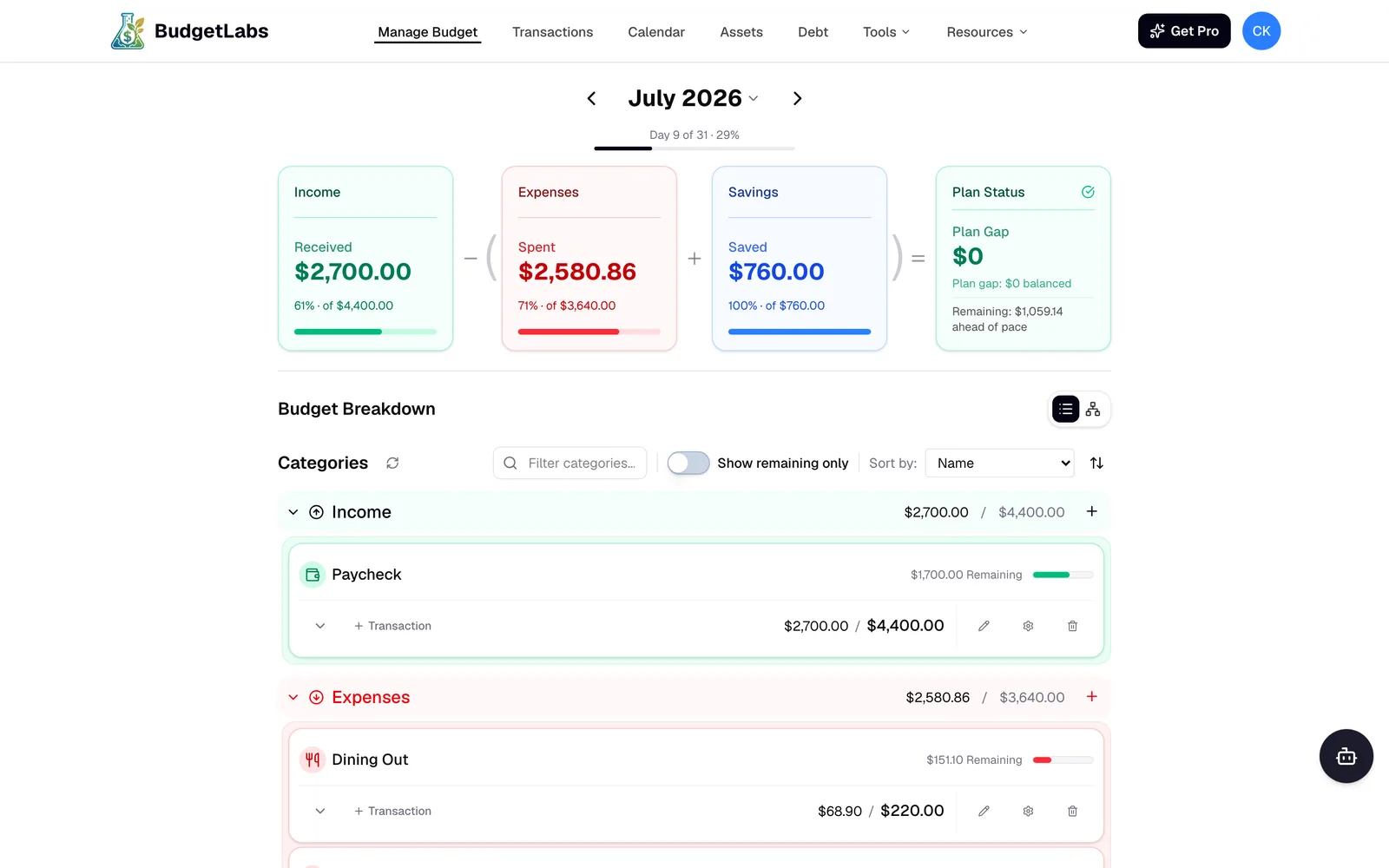
The actual BudgetLabs dashboard — every dollar assigned, plan gap $0. See the full product tour →
Where it loses: it isn't a debit card and never will be, so for a 10-year-old it's the wrong shape entirely — buy Greenlight. It has no Android app yet (iPhone, iPad, Mac, and Desktop today), which matters if your teen is on a hand-me-down Android. And it won't build their credit like Step does.
Want to set up a teaching budget? BudgetLabs runs full zero-based budgeting, with Pro adding Family Sharing for up to five, a separate budget per learner, and transfer-on-graduation — at $1.99/mo, with a free tier that covers the entire core loop.
→ Start a free budget in 2 minutes
How I'd actually sequence it
If you're starting from zero with a 12-year-old, the path that works is roughly: card app at 12, add a real budget at 15, drop the card app at 17, hand them the budget at 18. The overlap years are the important ones — that's when they still have your guardrails and a plan they wrote themselves, which is the only combination where mistakes are cheap enough to learn from.
The mistake I see most is skipping the middle. Families run a card app until 18, then hand a kid a checking account and a debit card with no planning habit attached, and are surprised when the first semester goes badly.
Frequently Asked Questions
What's the best budgeting app for a teenager?
It depends on age. Under 13, a card-and-controls app like Greenlight. Fourteen to seventeen, a card app plus a real budgeting app they own — BudgetLabs ($19.99/yr, free tier) or EveryDollar's free manual tier. Enrolled in college, YNAB's free 365-day student plan is the best value available, full stop.
Are there free budgeting apps for teens?
Yes. BudgetLabs has a free tier that covers the whole core budgeting loop, EveryDollar's free tier is a usable manual zero-based budget, and Goodbudget offers free envelope budgeting. Step is free to use as a banking app. YNAB is free for a year for enrolled college students, though $109/yr afterward.
At what age should a kid start budgeting?
Card-and-chore apps work from about 8. Actual budgeting — planning money before it's spent — tends to click around 14, when they have irregular income from a job or allowance and real decisions to make about it. Before that, the concept is usually too abstract to stick.
Do teens need a budgeting app with bank sync?
Usually not, and often the opposite. Many teen accounts don't connect cleanly to budgeting tools, and automatic categorization removes the exact step that teaches awareness. Manual or semi-manual entry is a feature at this age. See Best Budgeting App Without Bank Sync.
Is Greenlight or Acorns Early better?
Greenlight for deeper parental controls and up to five kids; Acorns Early for stronger educational content and younger children. Note that Acorns Early is the rebranded GoHenry, so older reviews under the GoHenry name still broadly apply.
Can my teen and I share one budgeting app subscription?
Yes with several. BudgetLabs Family Sharing covers up to 5 people on one Pro subscription with no per-seat charge, and Pro also lets you own a separate budget for each learner. YNAB covers up to 6 people on one subscription. EveryDollar offers spouse sharing.
Related reading
- Teaching Budgets: How to Help Your Kid Learn to Budget Without Doing It for Them
- Best Budgeting App for College Students in 2026 (Honest Ranking)
- Best Budgeting App for Families in 2026 (Honest Ranking)
- One Family Budget, Separate Bank Accounts: Why Family Sharing Just Works
- The Roommate Budget: Split Groceries and Utilities Without the Group-Chat Chaos
- 11 Best YNAB Alternatives in 2026 (From $1.99/mo)
- Zero-Based Budgeting: A Practical Guide
Take control of your money with BudgetLabs
Free forever — premium features just $1.99/mo. No credit card required.
Sign Up NowChris
Founder, BudgetLabs
One honest budgeting-app comparison a month
No spam, unsubscribe anytime.
Keep reading
- Best Budgeting App for Families in 2026 (Honest Ranking)The best budgeting apps for families in 2026, ranked by what actually matters for a household: multi-member sharing without per-seat fees, permissions, teaching kids, method, and price. Plus how family budgeting apps differ from kids' allowance apps.
- Best Budgeting App for College Students in 2026 (Honest Ranking)The best budgeting apps for college students in 2026, ranked by a founder who competes with all of them. Free tiers that are actually free, YNAB's student deal, roommate expense splitting, and the parent-owned teaching budget nobody else talks about.
- Best Budgeting App for Couples in 2026 (Honest Ranking)The best budgeting apps for couples in 2026, ranked by what actually matters for two people: shared access, permissions, method, and price — from a free option to the best all-rounder.