EveryDollar Pricing 2026: Free vs Premium, Honestly
August 17, 2026
Updated August 30, 2026
EveryDollar Premium costs $17.99/mo or $79.99/yr in 2026, and the free tier is manual-entry only. Here's exactly what the paywall separates, what the monthly plan really costs you, and when Premium is genuinely worth it.
Take control of your money with BudgetLabs
Free forever — premium features just $1.99/mo. No credit card required.
Sign Up NowDisclosure before anything else: I built BudgetLabs, a zero-based budgeting app that competes with EveryDollar at $19.99/yr. I've kept my pitch to one labeled section at the end. Everything before it is a straight accounting of what EveryDollar costs and what you get.
The question most people are actually asking isn't "what does EveryDollar cost" — it's "is the free version good enough, or am I going to hit a wall?" So let's answer that one directly.
The numbers
| Plan | Price | Effective monthly |
|---|---|---|
| Free | $0 | $0 |
| Premium (monthly) | $17.99/mo | $17.99 |
| Premium (annual) | $79.99/yr | $6.67 |
| Free trial | 14 days of Premium | $0 |
Pricing checked August 2026 against Ramsey Solutions' own help documentation.
The monthly plan is a trap. $17.99 × 12 = $215.88 against $79.99 for the year. You'd pay $135.89 extra — a 170% premium — for the privilege of month-to-month. That's one of the widest monthly-versus-annual gaps in the category. If you're going Premium, go annual.
At $17.99/mo, EveryDollar also carries the highest monthly sticker price of any mainstream budgeting app — above YNAB's $14.99 and Monarch's $14.99. The annual price is where it becomes reasonable.
What the paywall actually separates
This is the part that matters, and it's simpler than most reviews make it:
Free tier: a complete, genuine zero-based budget. You plan every dollar, create categories, and enter transactions by hand. That's it — and for a lot of people, that's the whole job.
Premium adds: bank connection and automatic transaction import, paycheck planning, the financial roadmap, and deeper tracking features.
So the real question is narrow: is typing in your own transactions worth $79.99 a year to avoid?
For some people, absolutely — if you run 200 transactions a month across four cards, manual entry will kill the habit inside three weeks. For others it's the opposite: manual entry is the discipline, and automating it away is how you end up with a beautifully categorized record of overspending you never noticed doing.
Be honest with yourself about which one you are. That single question decides your answer, not any feature list.
Is EveryDollar Premium worth it?
Worth it: you're actively working the Baby Steps. The coherence is the product. The app, Financial Peace University, the show, and the community all reinforce one plan. If the Ramsey ecosystem is why budgeting sticks for you, paying inside it is rational — you're buying alignment, not features.
Worth it: high transaction volume and a track record of quitting. If you've abandoned budgets before specifically because data entry got tedious, bank sync is worth real money.
Not worth it: you want the method but not the doctrine. EveryDollar is opinionated by design — debt payoff is snowball only, with no avalanche option, because that's the Ramsey teaching. If you'd rather pay highest-interest-first, you'll be fighting the tool. See Debt Snowball vs Avalanche for what that choice actually costs.
Not worth it: your budget is simple. Two accounts and thirty transactions a month? The free tier is genuinely fine. Don't pay $79.99 to avoid four minutes a week.
Not worth it if price is the deciding factor. $79.99/yr buys zero-based budgeting plus bank sync. Several apps do zero-based budgeting for a fraction of that, and one of them is mine — flagged below.
The comparison people actually run
EveryDollar sits in a specific spot: cheaper than Monarch's $99.99/yr and YNAB's $109/yr, more expensive than most of the independent field. Where it wins is the Ramsey ecosystem; where it loses is flexibility.
If you're weighing it against a specific competitor, these go deeper:
- YNAB vs EveryDollar — the two big zero-based methods head to head
- Monarch vs EveryDollar — methodology app versus dashboard
- Rocket Money vs EveryDollar — tracker versus budget
- EveryDollar vs Goodbudget — zero-based versus envelopes
The labeled bias section: the cheaper zero-based option
My product, clearly marked so you can skip it.
Take control of your money with BudgetLabs
Free forever — premium features just $1.99/mo. No credit card required.
Sign Up NowBudgetLabs runs full zero-based budgeting at $1.99/mo or $19.99/yr — a quarter of EveryDollar Premium — with a free tier that covers the entire core loop and no trial clock. Debt payoff supports snowball and avalanche, with live what-if forecasting. Family Sharing, on Pro, covers up to 5 people with no per-seat charge.
On the manual-versus-sync question, BudgetLabs takes a third path: there's no bank sync by design, but Smart Import parses a pasted statement, a PDF, a screenshot, or a forwarded email with AI, flags likely duplicates, and you approve what lands — free accounts get one import a day, Pro raises that to 100. You skip the typing without skipping the looking.
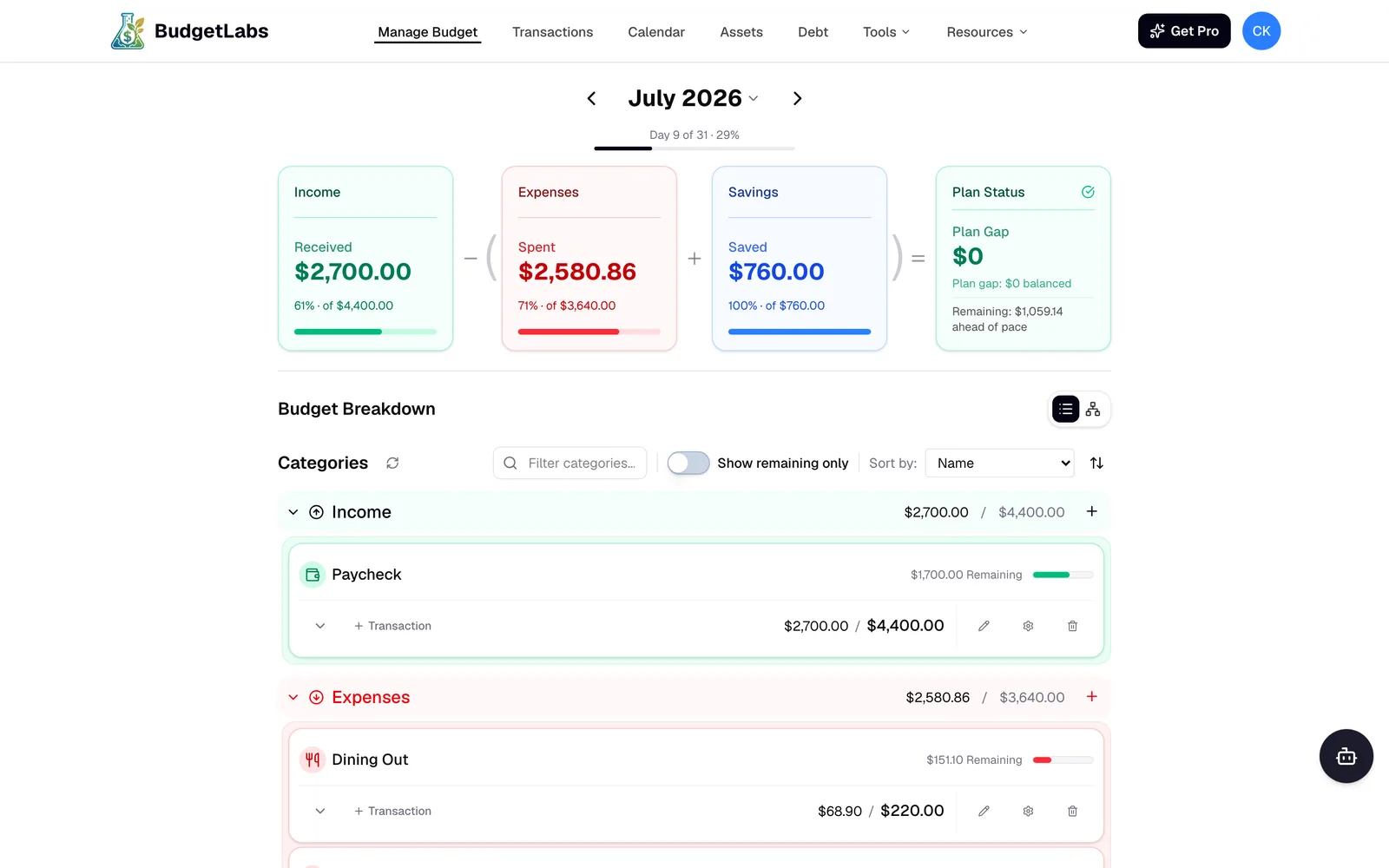
The actual BudgetLabs dashboard — every dollar assigned, plan gap $0. See the full product tour →
Where EveryDollar genuinely wins: the Ramsey ecosystem is a real support structure and nothing I build replaces it. If Financial Peace University is why you're budgeting at all, stay where your community is. EveryDollar also has a native Android app; BudgetLabs is iPhone, iPad, Mac, and Desktop today, with Android on the roadmap.
The full head-to-head is BudgetLabs vs EveryDollar, and the ranked field is 9 Best EveryDollar Alternatives in 2026.
Want zero-based budgeting for a quarter of the price? BudgetLabs runs the full method — snowball and avalanche debt payoff, with Family Sharing for up to five and AI Smart Import on Pro (free accounts get one import a day, Pro raises that to 100) — at $1.99/mo, with a free tier that covers the entire core loop. No credit card, no trial countdown.
→ Start a free budget in 2 minutes
Frequently Asked Questions
How much does EveryDollar Premium cost?
$17.99/month or $79.99/year. The annual plan works out to $6.67/month and saves $135.89 compared with paying monthly.
Is EveryDollar free?
Yes, there's a genuinely free tier — a complete zero-based budget with manual transaction entry. Bank sync, paycheck planning, and the financial roadmap require Premium.
What's the difference between EveryDollar free and Premium?
Free gives you the full budgeting method with manual entry. Premium adds automatic bank connection and transaction import, paycheck planning, the financial roadmap, and deeper tracking. The core budgeting experience is the same.
Is there an EveryDollar free trial?
Yes — 14 days of Premium.
Is EveryDollar Premium worth it?
Worth it if you're working the Baby Steps, or if you have high transaction volume and have quit budgets before because manual entry got tedious. Not worth it if your finances are simple, or if you want avalanche debt payoff, which EveryDollar doesn't offer.
Why is EveryDollar's monthly plan so expensive?
$17.99/mo is the highest monthly sticker in the mainstream budgeting category — higher than YNAB or Monarch. The annual plan at $79.99 is the competitive number; the monthly price effectively pushes you toward it.
What's cheaper than EveryDollar Premium?
BudgetLabs at $19.99/yr with a free tier, Goodbudget's free envelope tier, Actual Budget at $4/mo hosted or free self-hosted, and EveryDollar's own free tier if manual entry works for you. Full ranking in 9 Best EveryDollar Alternatives in 2026.
Related reading
- BudgetLabs vs EveryDollar: Honest 2026 Comparison
- 9 Best EveryDollar Alternatives in 2026 (Honest Ranking)
- YNAB vs EveryDollar: Which Budget App Wins in 2026?
- Monarch vs EveryDollar: Which Wins in 2026?
- EveryDollar vs Goodbudget: Zero-Based vs Envelopes (2026)
- Debt Snowball vs. Avalanche: Which One Actually Gets You Debt-Free Faster?
- Zero-Based Budgeting: A Practical Guide
Take control of your money with BudgetLabs
Free forever — premium features just $1.99/mo. No credit card required.
Sign Up NowChris
Founder, BudgetLabs
One honest budgeting-app comparison a month
No spam, unsubscribe anytime.
Keep reading
- Rocket Money vs EveryDollar: Which Wins in 2026?Rocket Money vs EveryDollar, decided: Rocket Money to find money you're already leaking, EveryDollar to plan money you haven't spent yet. They solve opposite problems — plus the $19.99/yr option that does the planning without the doctrine.
- 9 Best EveryDollar Alternatives in 2026 (Honest Ranking)9 EveryDollar alternatives ranked by a founder who competes with all of them — from $1.99/mo. The cheapest, the closest zero-based options, the best free tiers, and who should actually stay on EveryDollar.
- YNAB vs EveryDollar: Which Budget App Wins in 2026?YNAB ($109/yr) vs EveryDollar ($79.99/yr Premium): two zero-based budgets, two very different philosophies. An honest 2026 head-to-head — plus the $19.99/yr zero-based option neither camp talks about.