9 Best EveryDollar Alternatives in 2026 (Honest Ranking)
July 1, 2026
Updated September 15, 2026
9 EveryDollar alternatives ranked by a founder who competes with all of them — from $1.99/mo. The cheapest, the closest zero-based options, the best free tiers, and who should actually stay on EveryDollar.
Take control of your money with BudgetLabs
Free forever — premium features just $1.99/mo. No credit card required.
Sign Up NowDisclosure first, as always: I built one of the apps on this list (BudgetLabs). I compete with EveryDollar and with everything ranked below it. That's exactly why this post has to be honest — if you leave EveryDollar for the wrong app, you'll be back to square one in three months, and no ref link is worth that.
If you're here, you've probably hit one of the four reasons people search for an EveryDollar alternative:
- The price. EveryDollar Premium is $17.99/mo or $79.99/yr — the highest monthly price in the budgeting category — and the free tier is manual-entry only, which most reviewers treat as a demo for the paid product.
- The Ramsey doctrine. Snowball-only debt payoff, an anti-credit-card worldview, the 15% retirement prescription. If you never bought into the Baby Steps (or you've outgrown them), you feel the friction every time you open the app.
- Missing tools. No amortization for annual bills (Funds are a manual workaround), limited reporting, no AI-assisted entry.
- You just want to pay less for what is, at its core, a zero-based budget you fill in yourself.
Whichever one brought you here, the good news is that 2026 is the best year yet to switch — the field is deep. Here's the honest ranking.
The side-by-side at a glance
| App | Monthly | Annual | Free tier | Bank sync | Method | Best for |
|---|---|---|---|---|---|---|
| BudgetLabs | $1.99 | $19.99 | Yes (full core loop) | No (AI Smart Import) | Zero-based, no dogma | Zero-based without the price or the doctrine |
| YNAB | $14.99 | $109 | No (34-day trial) | Optional | Zero-based, rule-driven | Methodology depth + community |
| Monarch | $14.99 | $99.99 (Core), $199 (Plus) | No (7-day trial) | Yes | Tracking + planning | Wealth-tracking households |
| Goodbudget | $10 | $80 | Yes (10 envelopes) | No | Envelope | Envelope traditionalists |
| Actual Budget | $4 (hosted) | — | Free (self-host) | Via SimpleFIN add-on | Zero-based | Self-hosters / open source |
| Simplifi | $5.99 | $35.88 (intro) | No (30-day trial) | Yes | Tracking + planning | Quicken refugees |
| PocketGuard | $12.99 | $74.99 | Yes (2 accounts) | Yes | "Safe to spend" tracking | Minimal-effort tracking |
| Empower | Free | Free | Yes (full dashboard) | Yes | Net-worth tracking | Free investment/net-worth view |
| Copilot Money | $13 | $95 (Family tier extra) | No (30-day trial) | Yes | Tracking + planning | Apple-ecosystem polish |
Pricing checked July 2026 against each company's pricing page. If anything has shifted since, the rough ranking still holds — but verify before subscribing.
What you're actually replacing
EveryDollar does three things: a zero-based monthly budget, the Baby Steps framework wrapped around it, and (on Premium) bank sync. When you switch, decide which of those you're keeping:
- Keeping zero-based, dropping Ramsey? Look at BudgetLabs, YNAB, or Actual Budget.
- Keeping the Baby Steps, dropping the price? You can run the Baby Steps in any app with goals and debt tools — more on that at the end.
- Dropping the "give every dollar a job" method entirely? Monarch, Simplifi, PocketGuard, or Empower are trackers, not budgets. Be honest with yourself about whether watching your money will change your behavior the way planning it did.
The ranking
1. BudgetLabs — zero-based budgeting without the doctrine, at $1.99/mo
The one I built, so weigh my bias accordingly. BudgetLabs exists for almost exactly the person leaving EveryDollar: you like zero-based budgeting, you don't need Dave Ramsey's worldview enforced by your software, and you noticed that $79.99/yr is a lot to pay for a budget you type into yourself.
Where it beats EveryDollar:
- Price: $1.99/mo or $19.99/yr — roughly a quarter of EveryDollar Premium's annual price, a ninth of its monthly. And the free tier covers the entire core loop (dashboard, transactions, categories, debt and asset tracking, the Lab), not a manual-entry demo.
- Debt payoff your way: avalanche or snowball, with a live what-if chart — drag a slider for an extra monthly payment and watch months saved and interest saved recalculate. EveryDollar is snowball-only.
- Transaction amortization built in: log the $1,200 annual insurance bill once, spread it across 12 months in one tap. No more maintaining Funds as a side ledger.
- Annual Events Planner: 1, 2, 3, 5, and 10-year renewals (car registration, passport, permits) that pop into the right month's budget automatically.
- AI where it saves time: Smart Import parses pasted statements, PDFs, screenshots, or a dragged-in email — you review before anything lands (one import a day free, 100 a day on Pro). Hank, the AI coach, answers "how much did I spend on groceries last month?" in plain English. Receipt scanning is unlimited on both tiers.
- Family Sharing: up to 5 members on one Pro subscription, no per-seat charge. EveryDollar Premium covers you plus one spouse.
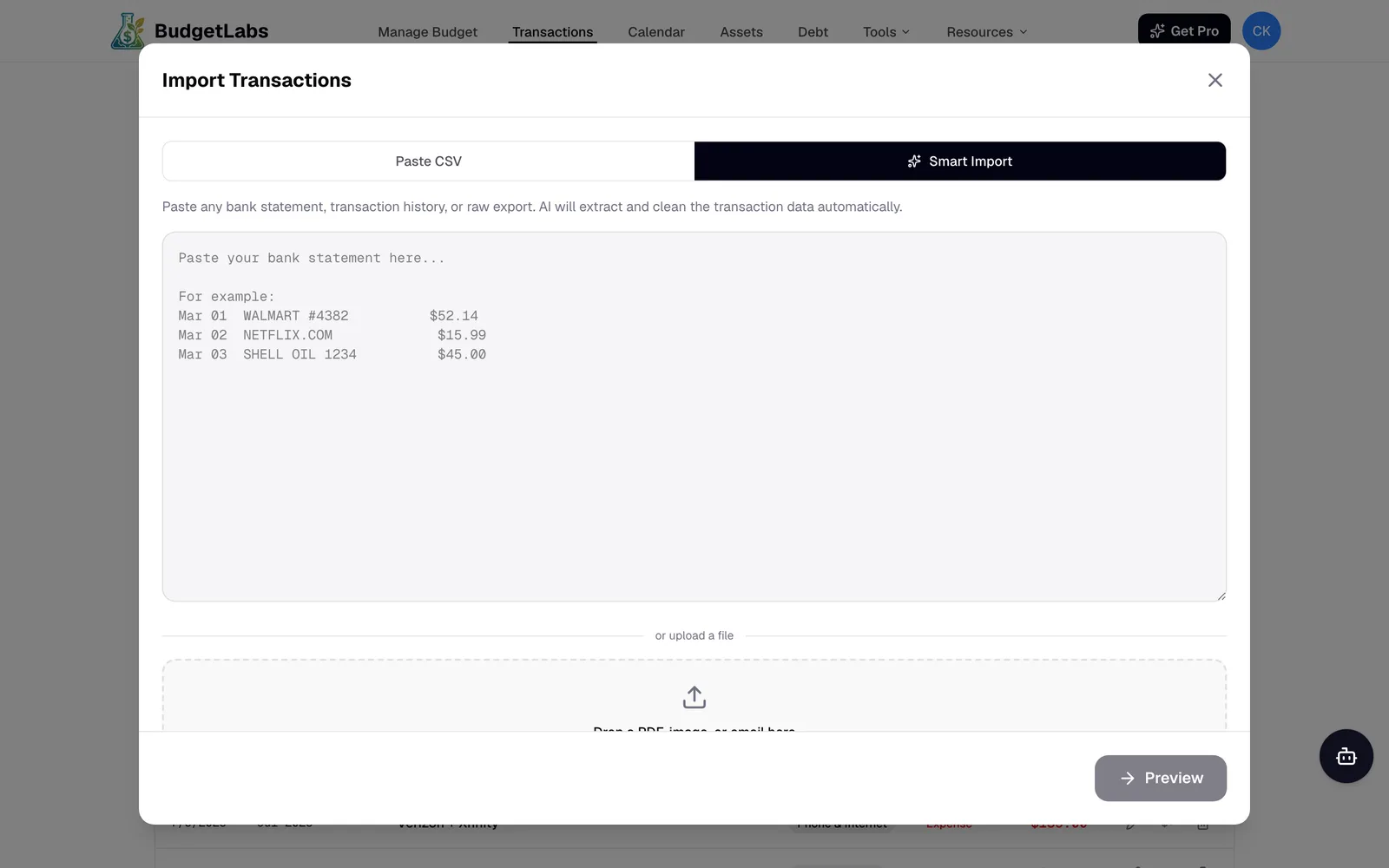
Smart Import in the actual app — the transaction entry EveryDollar's free tier doesn't have, without paying $79.99/yr for bank sync. Paste, review, approve. See the full product tour →
Where EveryDollar beats it: native Android app (BudgetLabs is iPhone/iPad/Mac/Desktop; Android is on the roadmap, so Android users are on the web app for now), true background bank sync if you pay for Premium, and the Ramsey ecosystem itself if that community is what keeps you budgeting.
The full head-to-head, including the migration path for your Funds, is here: BudgetLabs vs EveryDollar.
2. YNAB — the deepest zero-based methodology, at the highest price
If EveryDollar felt too shallow rather than too preachy, YNAB is the answer. The Four Rules are a more flexible, more powerful zero-based system than the Baby Steps — age your money, roll with the punches, embrace true expenses. The community (Reddit, YouTube, certified coaches) is the largest in the category.
The catch: $14.99/mo or $109/yr, no free tier, and a genuinely steep learning curve — expect a few weeks of feeling dumber before it clicks. You'd be switching away from the category's second-highest price to its co-highest. Worth it if methodology depth is why you're leaving; not if price is. Deep dive: YNAB vs EveryDollar.
3. Monarch Money — for "show me everything," not "hold me accountable"
Monarch is the most polished finance dashboard on the market: net worth, investments, household sharing for up to 5, beautiful UI. But understand what you'd be trading — Monarch doesn't force a zero-based plan. It shows you what happened; it doesn't make you decide in advance. People who needed EveryDollar's structure to stop overspending often drift on Monarch.
Take control of your money with BudgetLabs
Free forever — premium features just $1.99/mo. No credit card required.
Sign Up Now$14.99/mo, $99.99/yr Core, $199/yr Plus, no free tier. If you're past paycheck-to-paycheck and your question is "how are we doing overall?", it's excellent. Full comparison: Monarch vs EveryDollar.
4. Goodbudget — the envelope system, faithfully
If what you liked about EveryDollar was the discipline and what you disliked was everything else, Goodbudget's digital envelopes are the most tactile version of "spend only what's allocated." The free tier (10 envelopes, 2 devices) is genuinely usable — not a demo — and Plus is $10/mo or $80/yr. The trade-offs: dated UI, thin reporting, and rigidity that is the point rather than a bug. Head-to-head: EveryDollar vs Goodbudget.
5. Actual Budget — free if you're technical
Open-source, zero-based, YNAB-style. Self-host it for nothing, or pay $4/mo hosted. Bank sync needs a separate SimpleFIN subscription. If you're comfortable running a server (or a Docker container), this is the best price-to-method ratio on the list. If "self-host" sounds like a chore, it is one — pick something above.
6. Simplifi — the tracker for Quicken refugees
$5.99/mo (intro $35.88 first year), solid bank sync, good spending-trend reports. It's a tracker with planning features, not a zero-based budget — the same behavioral caveat as Monarch applies, at a friendlier price.
7. PocketGuard — one number, minimal effort
Its whole pitch is the "In My Pocket" number: what you can safely spend after bills and goals. Free tier is capped (2 accounts); Plus is $12.99/mo or $74.99/yr. If EveryDollar was too much work and you want almost none, this is that — but expect correspondingly less control.
8. Empower — free, but it's not a budget
The free dashboard (formerly Personal Capital) is the best no-cost net-worth and investment tracker available. There's no zero-based workflow at all, and if your linked assets are sizable, expect a call from their advisory arm. Great alongside a budgeting app; not a replacement for one.
9. Copilot Money — Apple polish, tracker philosophy
Apple Design Award-winning UI, live brokerage sync, smart auto-categorization. $13/mo or $95/yr, with household sharing on a pricier Family tier. iPhone, iPad, and Mac plus a web app; no Android. It's the prettiest way to watch your money — which, again, is a different activity than budgeting it.
Can I keep the Baby Steps without EveryDollar?
Yes — the Baby Steps are a plan, not a software feature. Any app with savings goals and flexible debt tools can run them. In BudgetLabs specifically: the $1,000 starter fund and 3–6 months of expenses are Emergency Fund goals in the Lab with live trajectory charts; debt payoff runs snowball if you want to stay orthodox (or avalanche if you've done the interest math); and the 15% retirement target maps to Asset Contribution Tracking, which also warns you at IRS contribution limits. Same steps, your choice of tool — and the price difference funds Baby Step 1 by itself.
How to migrate off EveryDollar
- Export your data: Settings → Account → Download Your Data gives you a CSV.
- Rebuild your category structure first in the new app — don't import into an empty shell.
- Import at least 3 months of history so the new app shows you something real.
- Convert your Funds. This is the EveryDollar-specific step: each sinking Fund becomes either a savings goal or (in BudgetLabs) a single amortized transaction spread across the months it covers.
- Give it a full month. The first month in any new budgeting app feels worse than what you left. Judge at month two.
The honest bottom line
If you're leaving EveryDollar over price while keeping zero-based budgeting: BudgetLabs ($19.99/yr) or Actual Budget (free, self-hosted) are the rational picks. If you're leaving over methodology depth: YNAB. If you're leaving budgeting itself for whole-picture tracking: Monarch or, for free, Empower. And if you're working the Baby Steps happily and just wandered in here — honestly, stay on EveryDollar. The best budgeting app is the one you'll still open in March.
Want the cheapest zero-based pick on this list? BudgetLabs runs full zero-based budgeting — snowball and avalanche debt payoff, with Family Sharing for up to five and AI Smart Import on Pro (free accounts get one import a day, Pro raises that to 100) — at $1.99/mo, with a free tier that covers the entire core loop. No credit card, no trial countdown.
→ Start a free budget in 2 minutes
Frequently Asked Questions
What is the best free alternative to EveryDollar?
BudgetLabs and Goodbudget have the most usable free tiers among budgeting apps — BudgetLabs's covers the full core loop (categories, transactions, debt, assets, the Lab), and Goodbudget's gives you 10 envelopes. Actual Budget is completely free if you self-host. Empower is free too, but it's a net-worth tracker, not a budget.
Is there an EveryDollar alternative without the Dave Ramsey methodology?
That's most of this list. BudgetLabs, YNAB, and Actual Budget all run zero-based budgets with no baked-in doctrine — use credit cards or don't, pay debts by snowball or avalanche, save whatever percentage fits your life.
What's cheaper than EveryDollar Premium?
Almost everything. EveryDollar Premium is $79.99/yr; BudgetLabs is $19.99/yr, Actual Budget's hosted plan is $4/mo, Simplifi's intro year is $35.88, and PocketGuard Plus is $74.99/yr. Only YNAB ($109/yr) and Monarch ($99.99–$199/yr) cost more annually.
Does any EveryDollar alternative support the debt snowball?
Yes — snowball isn't Ramsey-exclusive. BudgetLabs and YNAB both support snowball payoff; BudgetLabs also adds avalanche with live payoff forecasting, so you can compare the two strategies on your own debts before committing. See Debt Snowball vs. Avalanche.
Can I import my EveryDollar data into another app?
Yes. EveryDollar exports a CSV via Settings → Account → Download Your Data, and every serious alternative accepts CSV imports. In BudgetLabs, Smart Import also handles the messier cases — pasted statement text, PDFs, or screenshots — with duplicate detection before anything saves.
Related reading
- The EveryDollar Alternative Without the Ramsey Doctrine — the dedicated switcher's guide with 5-year price math
- BudgetLabs vs EveryDollar: Honest 2026 Comparison
- Monarch vs EveryDollar: Which Wins in 2026?
- YNAB vs EveryDollar: Which Budget App Wins in 2026?
- EveryDollar vs Goodbudget: Zero-Based vs Envelopes
- 11 Best YNAB Alternatives in 2026 (From $1.99/mo)
- Zero-Based Budgeting: A Practical Guide
- EveryDollar Pricing 2026: Free vs Premium, Honestly
Take control of your money with BudgetLabs
Free forever — premium features just $1.99/mo. No credit card required.
Sign Up NowChris
Founder, BudgetLabs
One honest budgeting-app comparison a month
No spam, unsubscribe anytime.
Keep reading
- 11 Best YNAB Alternatives in 2026 (From $1.99/mo)11 YNAB alternatives ranked by a founder who tried them — from $1.99/mo. The cheapest, the closest clone, the best free tier, and the best free tracker, compared honestly.
- Best Zero-Based Budgeting Apps in 2026 (Honest Ranking)Only a handful of apps actually enforce zero-based budgeting — most just let you approximate it. Ranked by how strictly they hold you to the method, what they cost, and who each one genuinely fits. Prices checked August 2026.
- YNAB vs EveryDollar: Which Budget App Wins in 2026?YNAB ($109/yr) vs EveryDollar ($79.99/yr Premium): two zero-based budgets, two very different philosophies. An honest 2026 head-to-head — plus the $19.99/yr zero-based option neither camp talks about.