Monarch vs EveryDollar: Which Wins in 2026?
June 9, 2026
Updated August 30, 2026
Monarch vs EveryDollar, decided: EveryDollar for Ramsey-style zero-based budgeting, Monarch for a polished wealth dashboard — plus the $19.99/yr pick that beats both on price.
Take control of your money with BudgetLabs
Free forever — premium features just $1.99/mo. No credit card required.
Sign Up NowQuick disclosure before anything else: I'm the founder of BudgetLabs, a budgeting app that competes with both of these. I'll tell you when BudgetLabs is relevant at the end, but the body of this post is a straight referee's comparison — because if you're choosing between EveryDollar and Monarch, you deserve a real answer, not a bait-and-switch.
These two apps get compared constantly, which is funny, because they're almost opposites. EveryDollar is a methodology app: Dave Ramsey's zero-based budget, turned into software. Monarch is a dashboard app: connect everything, see everything, plan loosely on top. Picking between them is less about features and more about which relationship with money you want.
Bottom line up front
The short version: pick EveryDollar if you're following Dave Ramsey's Baby Steps and want the official, prescriptive tool that holds you to a plan. Pick Monarch if you're past paycheck-to-paycheck and mainly want to see your whole financial picture — investments, net worth, multiple accounts — in one polished dashboard. EveryDollar is a methodology; Monarch is a mirror. The rest of this post is the evidence behind that call — plus, near the end, the cheaper third option a lot of people running this exact comparison actually want.
The side-by-side
| EveryDollar | Monarch Money | |
|---|---|---|
| Monthly price | Free (manual) / $17.99 Premium | $14.99 |
| Annual price | $79.99 (Premium) | $99.99 (Core) / $199 (Plus) |
| Free tier | Yes — manual entry only | No (7-day trial) |
| Bank sync | Premium only | Yes (core to the product) |
| Methodology | Zero-based (Ramsey Baby Steps) | Tracking + flexible planning |
| Investment tracking | No | Yes — holdings, returns, net worth |
| Household sharing | Spouse sharing | Up to 5 members |
| Debt tools | Snowball (only) | Balance tracking, light planning |
| Platforms | iOS, Android, web | iOS, Android, web |
| Best for | Ramsey followers | Wealth-tracking households |
Pricing checked June 2026.
How I compared them
I've used both apps as a day-to-day budget, not just clicked through the trials. For this comparison I weighted five things: the budgeting method each one pushes you toward, what the free tier actually does, total cost over a year, how the mobile and desktop apps feel in daily use, and how painful it is to leave (i.e. exporting your data). Prices were re-checked in June 2026 against each company's pricing page. Where I'm biased — I build a competing app — I flag it.
What EveryDollar actually is
EveryDollar is Ramsey Solutions' official app, and that lineage defines everything about it. The budget is zero-based: income minus every planned dollar should equal zero. Debt payoff is the snowball method — smallest balance first — because that's the Baby Steps way. There is no avalanche option. There's no credit card rewards optimization, because the Ramsey worldview says cut up your credit cards.
If you're working the Baby Steps, this coherence is a feature. The app, the podcast, Financial Peace University, and the community all reinforce the same plan. You never have to translate between your tool and your method.
The catch is the free/Premium split. Free EveryDollar is manual-entry only — workable, but most reviewers treat it as a demo. Bank sync, paycheck planning, and the financial roadmap require Premium at $17.99/mo or $79.99/yr, which is the highest monthly price in the budgeting category. You're paying brand-ecosystem prices for a feature set that's narrower than competitors at the same tier.
What Monarch actually is
Monarch is the most polished personal-finance dashboard on the market. Connect your checking, cards, mortgage, and brokerage, and it builds a live picture of your financial life: spending by category, net worth over time, investment holdings and returns, shared visibility for your household (up to 5 members).
Its budgeting layer is real but optional — and that's the philosophical difference. Monarch doesn't force you to give every dollar a job. It shows you what happened and lets you set targets. For couples where one person is "the money person" and the other just wants visibility, this is genuinely the better shape. For people who need guardrails to stop overspending, it can quietly become an expensive way to watch yourself drift.
Pricing moved upmarket in 2026: $99.99/yr for Core, $199/yr for the new Plus tier (forecasting, Morningstar analysis, business income tracking). There's no free tier, just a 7-day trial.
Mobile and desktop experience
Both run on iOS, Android, and the web, so platform coverage is a wash on paper. In daily use they feel different. EveryDollar is built around one screen — your budget — and it's fast to open, check a category, and log a transaction. It's deliberately narrow, which is part of why beginners like it: there's not much to get lost in.
Monarch is heavier. The dashboard pulls in accounts, investments, net worth, and trends, so there's more to load and more to look at. On a phone, that richness is occasionally a tradeoff — you open it to check one number and get the whole financial weather report. On a large screen, though, Monarch is the nicer thing to sit in front of; it's one of the best-looking finance apps on the web, full stop.
Quick rule of thumb: if you mostly budget from your phone in ten-second bursts, EveryDollar's focus wins. If you do a weekly money review on a laptop, Monarch's dashboard is the better seat.
Support, security, and getting your data out
Both are mature, reputable companies with bank-level encryption and standard security practices, so this isn't where the decision gets made — but two practical points matter.
First, bank connections. Monarch's whole model depends on aggregator sync (Plaid/Finicity), which means you'll occasionally hit the usual aggregator headaches: a connection that needs re-authenticating, a duplicate transaction, a renamed account. EveryDollar only has this surface area if you're on Premium, since sync is the paid feature; the free tier sidesteps it entirely by being manual.
Second, leaving. If you ever want out, both let you export to CSV — EveryDollar via Settings → Account → Download Your Data, Monarch via its transactions export. Worth knowing before you commit a year of history to either: your data isn't locked in, and you can carry it to whatever you pick next.
Head-to-head verdicts
Take control of your money with BudgetLabs
Free forever — premium features just $1.99/mo. No credit card required.
Sign Up NowBudgeting discipline: EveryDollar. Zero-based budgeting forces a decision about every dollar before the month starts. Monarch's flexible targets don't create the same accountability. If your problem is overspending, EveryDollar's structure helps more.
Seeing your whole financial picture: Monarch. Investments, net worth, multiple accounts, household sharing — Monarch was built for this and EveryDollar simply doesn't do it.
Debt payoff: EveryDollar, with a caveat. EveryDollar has real debt tooling, but it's snowball-only. If you want avalanche (highest interest first, mathematically cheaper) you'll need to fake it or go elsewhere. (If the avalanche method matters to you, it's worth knowing some newer apps — BudgetLabs among them — do snowball and avalanche on the free tier; more on that below.)
Value for money: neither is great, honestly. $79.99/yr buys you bank sync and the Ramsey roadmap. $99.99–$199/yr buys you the dashboard. Both are top-quartile prices in a category where capable apps now exist for a fifth of that.
Couples: Monarch. Multi-member sharing with mature permissions beats EveryDollar's spouse-sharing model.
Who should pick which
Pick EveryDollar if you're actively working the Baby Steps, you want the official tool, the snowball-only constraint matches your plan, and the ecosystem (FPU, the show, the community) is part of why budgeting sticks for you.
Pick Monarch if you're past the paycheck-to-paycheck stage, your money question is "how are we doing overall?" rather than "can I afford this?", you have meaningful investments, or you need household sharing with real permissions.
The third option both camps overlook
Here's where I declare my bias: a lot of people comparing these two apps actually want something in between — the discipline of zero-based budgeting without the Ramsey doctrine, at a price that doesn't undercut the point of budgeting.
That's the gap BudgetLabs was built for: full zero-based budgeting at $1.99/mo ($19.99/yr) — a quarter of EveryDollar Premium, a fifth of Monarch Core. Debt payoff supports snowball and avalanche with live what-if forecasting. Family Sharing, a Pro feature, covers up to 5 members at no per-seat charge. There's no bank sync by design — instead, Smart Import parses pasted statements, PDFs, or screenshots with AI and you approve what lands — free accounts get one import a day, Pro raises that to 100 — which keeps you engaged with your spending without the typing. The free tier covers the entire core loop, no trial clock.
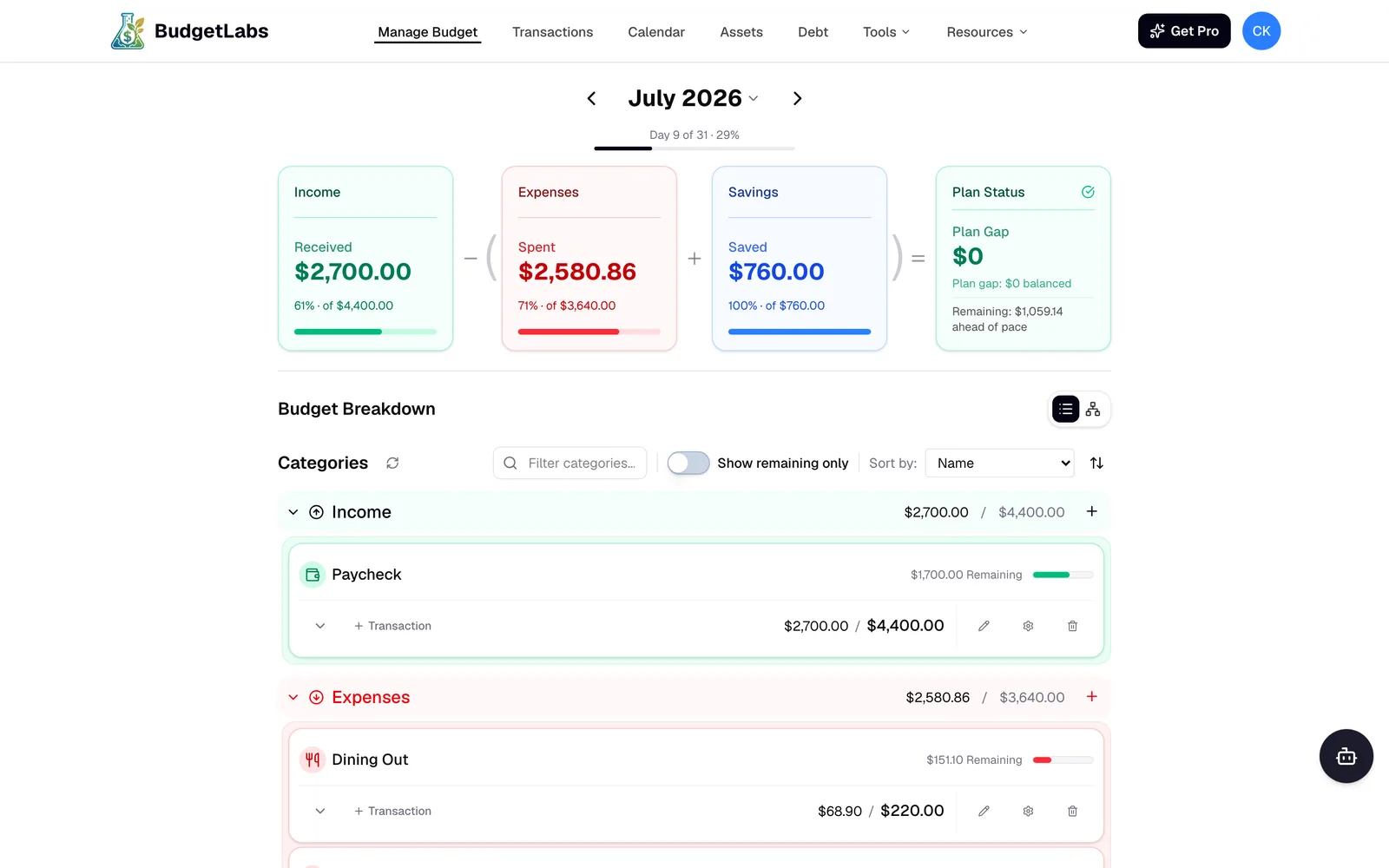
This is the actual BudgetLabs dashboard — every dollar assigned, plan gap $0. See the full five-screen product tour →
It won't pull your brokerage holdings like Monarch, and it isn't blessed by Dave Ramsey. But if the real question is "which app will make me deliberate about money without charging dashboard prices," it's worth the comparison: BudgetLabs vs EveryDollar and BudgetLabs vs Monarch are the honest deep-dives.
Want to try the third option free? BudgetLabs runs full zero-based budgeting — snowball and avalanche debt payoff, with Family Sharing for up to five and AI Smart Import on Pro (free accounts get one import a day, Pro raises that to 100) — at $1.99/mo, with a free tier that covers the entire core loop. No credit card, no trial countdown.
→ Start a free budget in 2 minutes
Frequently Asked Questions
Is EveryDollar or Monarch better for beginners?
EveryDollar is simpler to start: pick your income, plan your categories, done. Monarch's onboarding is heavier because it wants all your accounts connected first. But EveryDollar's free tier is manual-only — if you want bank sync on day one, Monarch includes it while EveryDollar charges $79.99/yr.
Which is cheaper, EveryDollar or Monarch?
EveryDollar Premium is $79.99/yr; Monarch is $99.99/yr for Core and $199/yr for Plus. So EveryDollar is the cheaper of the two — but both sit in the top price tier of the category. EveryDollar's free tier (manual entry) costs nothing, while Monarch has no free tier, only a 7-day trial. If price is the deciding factor, neither is the cheapest zero-based option on the market.
Does Monarch do zero-based budgeting?
Not natively. Monarch uses flexible category targets and rollover budgets; you can approximate zero-based budgeting, but the app won't hold you to "every dollar has a job" the way EveryDollar, YNAB, or BudgetLabs do.
Is EveryDollar worth it without Premium?
The free tier is a usable manual zero-based budget — honestly fine if you're disciplined. Most complaints come from people who expected bank sync; that's Premium-only at $17.99/mo or $79.99/yr.
Can I use EveryDollar and Monarch together?
Some people do — EveryDollar to plan the budget, Monarch to watch net worth and investments — but you're then paying two subscriptions ($180+/yr combined) and re-entering the same context twice. If that's the instinct, it's usually a sign you want one tool that does disciplined budgeting and whole-picture tracking, which is worth a look before you stack two.
What's cheaper than both?
BudgetLabs ($19.99/yr) and Actual Budget ($4/mo hosted, free self-hosted) both run zero-based budgets at a fraction of either price. Goodbudget's free envelope tier is also genuinely usable. For the full ranked field, see 9 Best EveryDollar Alternatives in 2026.
Related reading
- BudgetLabs vs EveryDollar: Honest 2026 Comparison
- BudgetLabs vs Monarch: $19.99/yr vs $99–199/yr
- 9 Best EveryDollar Alternatives in 2026 (Honest Ranking)
- YNAB vs Monarch Money: Method vs Dashboard
- YNAB vs EveryDollar: Which Zero-Based App Wins?
- 11 Best YNAB Alternatives in 2026 (From $1.99/mo)
- Debt Snowball vs. Avalanche: Which One Actually Gets You Debt-Free Faster?
- Zero-Based Budgeting: A Practical Guide
Take control of your money with BudgetLabs
Free forever — premium features just $1.99/mo. No credit card required.
Sign Up NowChris
Founder, BudgetLabs
One honest budgeting-app comparison a month
No spam, unsubscribe anytime.
Keep reading
- 9 Best EveryDollar Alternatives in 2026 (Honest Ranking)9 EveryDollar alternatives ranked by a founder who competes with all of them — from $1.99/mo. The cheapest, the closest zero-based options, the best free tiers, and who should actually stay on EveryDollar.
- EveryDollar Pricing 2026: Free vs Premium, HonestlyEveryDollar Premium costs $17.99/mo or $79.99/yr in 2026, and the free tier is manual-entry only. Here's exactly what the paywall separates, what the monthly plan really costs you, and when Premium is genuinely worth it.
- Rocket Money vs EveryDollar: Which Wins in 2026?Rocket Money vs EveryDollar, decided: Rocket Money to find money you're already leaking, EveryDollar to plan money you haven't spent yet. They solve opposite problems — plus the $19.99/yr option that does the planning without the doctrine.