Best Zero-Based Budgeting Apps in 2026 (Honest Ranking)
August 22, 2026
Updated August 30, 2026
Only a handful of apps actually enforce zero-based budgeting — most just let you approximate it. Ranked by how strictly they hold you to the method, what they cost, and who each one genuinely fits. Prices checked August 2026.
Take control of your money with BudgetLabs
Free forever — premium features just $1.99/mo. No credit card required.
Sign Up NowDisclosure up front: I built BudgetLabs, one of the apps on this list. My section is labeled and comes near the end, and I've named where each competitor genuinely beats it.
Here's the thing that makes this list shorter than you'd expect: most budgeting apps don't actually do zero-based budgeting. They let you set category targets and call it close enough. That's a different thing. Zero-based means income minus every assigned dollar equals zero — every dollar has a job before the month starts, and when you overspend somewhere, the app makes you take that money from somewhere specific.
Apps that enforce that are rare. Apps that permit an approximation of it are everywhere. This ranking is about the first group.
Bottom line up front
Most effective, most expensive: YNAB, $109/yr. The method taught properly, with the strongest community and teaching material in the category.
Cheapest with a real free tier: BudgetLabs, $19.99/yr, free tier covers the whole loop. That's mine — full disclosure, labeled section below.
Best if you follow Dave Ramsey: EveryDollar. The free tier is a complete manual zero-based budget.
Best free and self-hostable: Actual Budget. Free if you run it yourself, and genuinely good.
Best if envelopes click better than math: Goodbudget. Not strictly zero-based, but the same discipline in a shape some people find far more intuitive.
The field
| Price | Free tier | Enforces zero-based? | Bank sync | Sharing | |
|---|---|---|---|---|---|
| YNAB | $109/yr ($14.99/mo) | No — 34-day trial, free year for students | Yes, strictly | Yes | Up to 6 |
| BudgetLabs | $19.99/yr ($1.99/mo) | Yes, full core loop | Yes | No, by design | Up to 5 (Pro) |
| EveryDollar | Free / $79.99/yr Premium | Yes, manual entry | Yes | Premium only | Spouse |
| Actual Budget | Free self-hosted / ~$4/mo hosted | Yes, self-hosted | Yes | Limited | Yes |
| Goodbudget | Free tier + paid plan | Yes | Envelopes, not ZBB | No | Household |
| Monarch | $99.99/yr | No | No — targets only | Yes | Up to 5 |
| Copilot | $95/yr | No | No — targets only | Yes | Family tier |
| Quicken Simplifi | ~$47.88/yr | No | No — auto Spending Plan | Yes | One other person |
Prices checked August 2026 against each company's own pages.
The bottom three are in the table specifically because they get recommended for zero-based budgeting constantly and shouldn't be. They're good apps. They just don't do this.
The rankings
1. YNAB — the method, taught properly
$109/yr, and the honest case for paying it: YNAB isn't selling software, it's selling a curriculum. Four rules, extensive free education, workshops, and a large genuinely helpful community. If three previous budgeting attempts have failed, that teaching apparatus is what you're buying and it's worth real money.
Mechanically it's the strictest implementation available. Overspend a category and you must cover it from another one — you can't note the overage and move on. That friction is the product.
The catch: it's the most expensive option here, there's no free tier, and paying monthly costs $179.88/yr — a 65% premium over annual. Also worth knowing: enrolled college students get a free 365-day plan, which is the best value in the entire category. Full numbers in YNAB Pricing 2026.
2. EveryDollar — best free manual zero-based budget
The free tier is a complete, genuine zero-based budget with manual transaction entry. For a simple financial life — two accounts, thirty transactions a month — that's the whole job, at no cost.
Premium ($17.99/mo or $79.99/yr) adds bank sync, paycheck planning, and the Ramsey financial roadmap. If your household already runs the Baby Steps, the coherence between app, podcast, and community is worth a lot.
The catch: debt payoff is snowball-only, with no avalanche option, because that's the Ramsey teaching — so if you'd rather pay highest-interest-first you'll be fighting the tool. And $17.99/mo is the highest monthly sticker in the category. See EveryDollar Pricing 2026 and Debt Snowball vs Avalanche.
3. Actual Budget — best free option if you'll self-host
Open source, genuinely capable, and free if you run it on your own machine or server. Around $4/mo if you want it hosted for you. The budgeting model is solid zero-based and the community is active.
The catch: self-hosting is a real requirement, not a footnote. If "spin up a container" isn't a sentence you'd type voluntarily, the hosted option is the one to look at, and bank connectivity is more limited than the commercial apps.
4. Goodbudget — the same discipline, different shape
Envelope budgeting rather than strictly zero-based: you fund envelopes, and when an envelope is empty, you're done. A usable free tier, no bank connection required.
The catch: it isn't zero-based in the technical sense, and the free tier caps envelopes. But some people find envelopes dramatically more intuitive than assigning every dollar in a table — it's physical and visual. Worth ten minutes before deciding the ZBB model is the only one. More in EveryDollar vs Goodbudget.
5–7. Monarch, Copilot, Simplifi — good apps, not zero-based
Grouped, because the answer is the same for all three: they're excellent tracking apps with flexible category targets on top. You can approximate zero-based budgeting in them. None will hold you to it.
If someone recommended one of these to you as a zero-based app, they were being imprecise. Pick them because you want a beautiful dashboard of what already happened — a completely legitimate thing to want — not because you want the method. Origin vs Monarch vs Copilot covers that group properly.
Take control of your money with BudgetLabs
Free forever — premium features just $1.99/mo. No credit card required.
Sign Up NowThe labeled bias section: BudgetLabs
My app, fenced off.
BudgetLabs runs full zero-based budgeting at $1.99/mo or $19.99/yr, with a free tier that covers the entire core loop — no trial clock, no card required. A floating dashboard widget tells you whether you're in surplus (dollars still to assign) or deficit (planned more than income covers), with a one-click path to fix either. Debt payoff does snowball and avalanche with live what-if forecasting.
On Pro, Family Sharing covers up to 5 people at no per-seat charge, and you can run up to 5 separate budgets — useful for teaching a kid with their own budget you can later transfer to them.
There's no bank sync by design. Smart Import parses a pasted statement, PDF, screenshot, or forwarded email, flags likely duplicates, and you approve what lands — free accounts get one import a day, Pro raises that to 100. You skip the typing without skipping the looking.
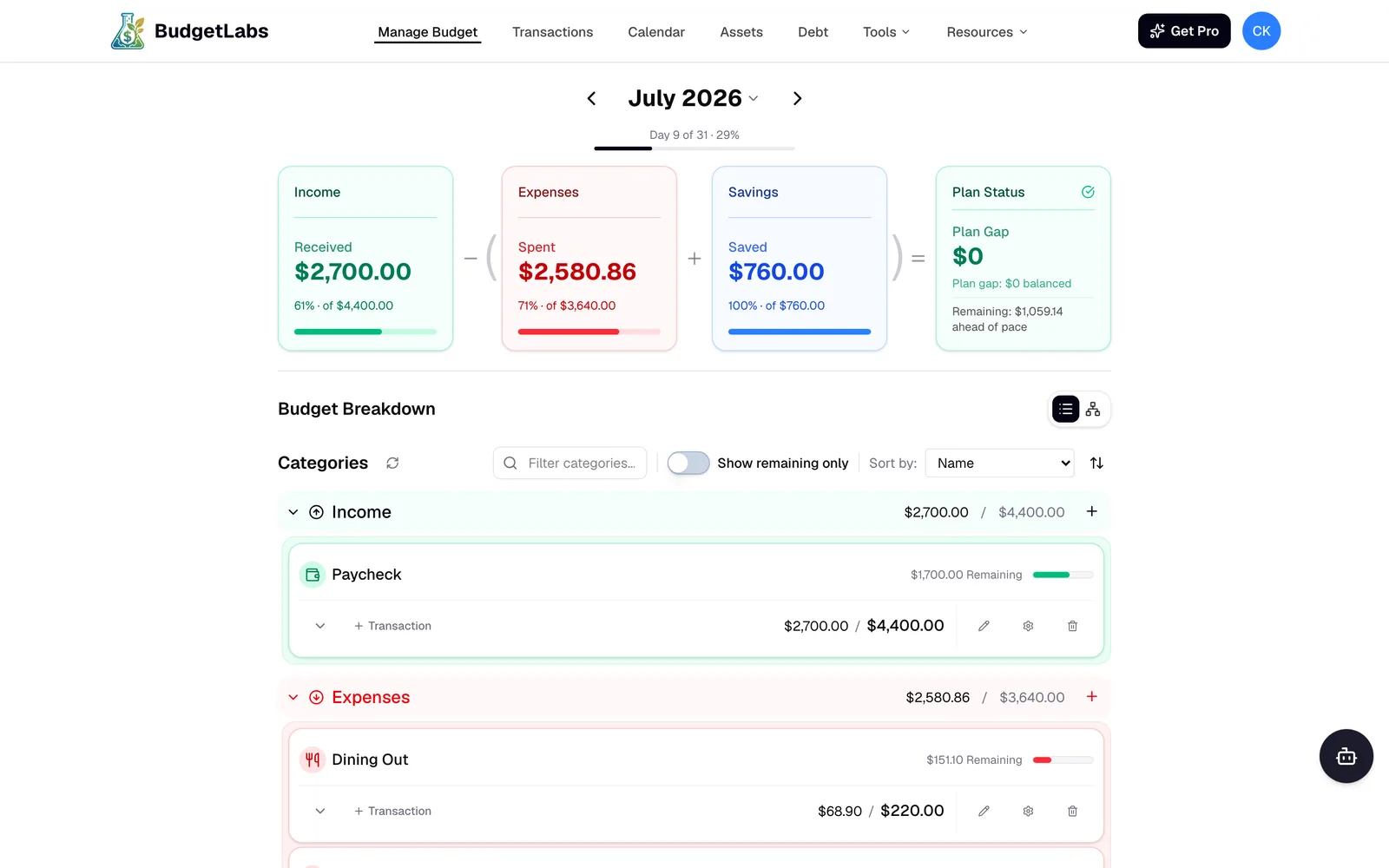
The actual BudgetLabs dashboard — every dollar assigned, plan gap $0. See the full product tour →
Where the others genuinely beat it: YNAB's teaching material and community are better than anything I offer, and it has a native Android app — BudgetLabs is iPhone, iPad, Mac, and Desktop today. EveryDollar's Ramsey ecosystem is a real support structure I can't replicate. Actual Budget is free forever if you'll self-host. And if you want bank sync, I've deliberately not built it, so any of the paid options above will serve you better.
Head-to-heads: BudgetLabs vs YNAB and BudgetLabs vs EveryDollar.
Want zero-based budgeting without a $109 subscription? BudgetLabs runs the full method — snowball and avalanche debt payoff, with Family Sharing for up to five and AI Smart Import on Pro (free accounts get one import a day, Pro raises that to 100) — at $1.99/mo, with a free tier that covers the entire core loop. No credit card, no trial countdown.
→ Start a free budget in 2 minutes
How to pick
- Never made budgeting stick before? YNAB. Pay for the teaching.
- Already running the Baby Steps? EveryDollar, free tier first.
- Want the method cheaply, or want to try before paying anything? BudgetLabs' free tier, or Actual Budget if you'll self-host.
- Comfortable with servers and want it free forever? Actual Budget.
- Find the math abstract? Goodbudget's envelopes.
- Actually want a dashboard, not a method? Be honest about that and pick Monarch or Copilot instead — you'll be happier.
If you're new to the method itself rather than shopping for software, start with Zero-Based Budgeting: A Practical Guide — the app matters much less than understanding what you're doing.
Frequently Asked Questions
What is a zero-based budgeting app?
One that makes you assign every dollar of income to a category until income minus assignments equals zero. The distinguishing feature is enforcement — when you overspend, the app requires you to move money from another category rather than just recording the overage.
What is the best zero-based budgeting app?
YNAB if you need the habit built and can pay $109/yr. BudgetLabs at $19.99/yr with a free tier if you want the method cheaply. EveryDollar's free tier if you follow Dave Ramsey. Actual Budget if you'll self-host.
Is there a free zero-based budgeting app?
Yes. BudgetLabs has a free tier covering the whole core loop, EveryDollar's free tier is a complete manual zero-based budget, and Actual Budget is free if you self-host. YNAB has no free tier, though enrolled college students get a free 365-day plan.
Does Monarch do zero-based budgeting?
No. Monarch uses flexible category targets and rollovers. You can approximate the method, but it won't hold you to it. The same is true of Copilot and Quicken Simplifi.
Do I need bank sync for zero-based budgeting?
No — and there's a reasonable argument it works against you. Automatic categorization removes the moment of attention that changes behavior. Several zero-based apps are manual or semi-manual by design. See Best Budgeting App Without Bank Sync.
What's the difference between zero-based and envelope budgeting?
Zero-based assigns every dollar to a category before the month starts. Envelope budgeting funds a set of envelopes and stops you when one is empty. The discipline is similar; envelopes are more visual and often easier for beginners.
Is zero-based budgeting worth the effort?
It's the most effective method for people who overspend, because it forces a decision about every dollar before it's spent rather than reporting on it afterward. If your problem is awareness rather than behavior, a tracking app is less work and will serve you fine.
Related reading
- Zero-Based Budgeting: A Practical Guide
- BudgetLabs vs YNAB: Same Method, Up to 87% Cheaper (2026)
- 11 Best YNAB Alternatives in 2026 (From $1.99/mo)
- 9 Best EveryDollar Alternatives in 2026 (Honest Ranking)
- YNAB Pricing 2026: What It Actually Costs
- EveryDollar Pricing 2026: Free vs Premium, Honestly
- EveryDollar vs Goodbudget: Zero-Based vs Envelopes (2026)
- Best Budgeting App Without Bank Sync (2026)
- Best Mint Alternatives in 2026 (Honest Ranking)
Take control of your money with BudgetLabs
Free forever — premium features just $1.99/mo. No credit card required.
Sign Up NowChris
Founder, BudgetLabs
One honest budgeting-app comparison a month
No spam, unsubscribe anytime.
Keep reading
- 9 Best EveryDollar Alternatives in 2026 (Honest Ranking)9 EveryDollar alternatives ranked by a founder who competes with all of them — from $1.99/mo. The cheapest, the closest zero-based options, the best free tiers, and who should actually stay on EveryDollar.
- 11 Best YNAB Alternatives in 2026 (From $1.99/mo)11 YNAB alternatives ranked by a founder who tried them — from $1.99/mo. The cheapest, the closest clone, the best free tier, and the best free tracker, compared honestly.
- YNAB vs EveryDollar: Which Budget App Wins in 2026?YNAB ($109/yr) vs EveryDollar ($79.99/yr Premium): two zero-based budgets, two very different philosophies. An honest 2026 head-to-head — plus the $19.99/yr zero-based option neither camp talks about.